
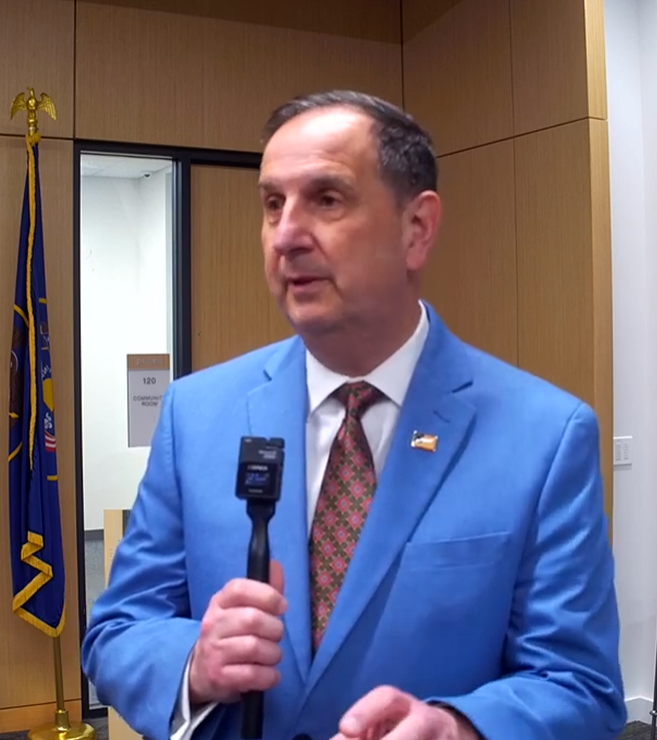
During the debate, we were given one minute to respond. I have included here my responses which have been edited and expanded for clarity.
| Question from Moderator | My Response |
| 3-part Question A. What is the state of Utah doing well that you would like to continue?” | There is so much happening well in Utah. We are consistently rated as the best-managed state in the country. Despite the fact that so much of our land is locked up by the federal government—restricting access to resources that should benefit our people—we continue to deliver for our families. Utah is a national leader in parental choice, local control, and transportation infrastructure. We are also doing a fantastic job managing our energy resources to maintain stability and growth. Most importantly, we have stayed focused on government efficiency, which allows us to keep your taxes low. For each of the past six years, we have successfully lowered taxes, resulting in a cumulative 11% decrease in your income tax. We need to keep that momentum going |
| B. What is the state of Utah doing that we would like to continue but needs improvement and how would you improve it? | If I were to pick one area of state government that involves significant taxpayer investment and needs improvement, it is our higher education system. We must do a better job of preparing students for the actual jobs they will fulfill. While there is nothing wrong with a bachelor’s degree, we’ve become too focused on the idea that every student needs one. Many students are better served by learning ‘real-world’ skills—the trades, such as electrical, plumbing, and HVAC, or specialized fields like long-haul trucking, coding, and technology. These are high-value paths that allow young people to become productive members of society and support their families. To improve this, we need to integrate Utah’s higher education system more effectively with our high schools, creating a seamless training-to-career pipeline. |
| C. What is the state of Utah doing that it should be—that you would like to discontinue? | While Utah is performing well overall, we can do much better by honoring the principle that the government closest to the people is the most effective. We must guard against and pull back from excessive state involvement in local affairs. We are not respecting local control quite enough. I frequently see legislative efforts to mandate curriculum or dictate rules to our school districts and cities. We need to step back a bit and return that authority to the school boards, city councils, and, most importantly, the parents, who know what is best for their own famiilies and communities. Whether it’s a school district or a city council, we should be empowering local leaders, not micromanaging them from the State Capitol. Additionally, we must stop clinging to inefficient, narrow taxes. For example, I have pushed to repeal the 1% restaurant tax and replace it with a better tax. By applying the economic principle to ‘broaden the base and lower the rate,’ we can actually provide counties with more stable funding for tourism while reducing the burden on a single industry. It’s about making our tax code work for everyone, not just special interests. |
| HB 572, passed in 2024, was intended to promote affordable housing. In the recent session HB492, HB68, and SB284 were passed to help alleviate Utah’s housing crisis. Yet housing affordability remains one of the top concerns of Utah voters. What are the underlying factors behind this affordability crisis and just how much can the legislature really do to address those factors? | So often when we face a crisis like housing affordability, we have to ask: is government the solution or the problem? In this case, government has tried to be the solution for years, and it hasn’t worked. The most effective thing we can do is get government out of the way. We must remove the regulatory restrictions that prevent builders from building and respect the market’s ability to perform its role. The marketplace is an incredibly powerful information tool. High prices are a signal—they are a message to the economy that tell innovators to find new ways to build and bring new opportunities to the table. When the state attempts what Hayek called the ‘Fatal Conceit,’ the idea that central planners can solve a crisis through subsidies or top-down mandates, we effectively blind the market, and it is destined to fail. These interventions strip away the very information the market needs to respond efficiently. We must stop trying to engineer outcomes from the State Capitol. Instead, let’s get the government out of the way, let the builders build, and let Utahns reap the benefits of a free-market system. |
| Southern Utah County communities are increasingly dependent on groundwater. What is your position on state-level water rights reform? | Utah’s water law is rooted in a priority system established by the pioneers, based on the principle that every drop of water belongs to the people of the state. While the system is arcane and historically dominated by agricultural rights, it has evolved into a remarkably effective water marketplace. This market allows for the transparent transfer of rights, enabling new homes and businesses to secure the water they need through open-market transactions. The key to our future, however, lies in how municipalities manage these assets. Provo and Springville were visionary in acquiring significant water rights decades ago, providing a vital foundation for our current growth. Additional Thought: I am particularly enthusiastic about Provo’s Managed Aquifer Recharge (MAR) project. By using our existing water rights to treat and inject surplus spring runoff directly into the ground, we are quite literally ‘refilling the bank.’ This is an environmentally friendly, water-wise strategy that prevents the massive evaporation losses common in surface reservoirs. It’s a perfect example of how we can respect traditional property rights while using modern ‘smart plumbing’ to secure a sustainable water supply for the next generation. |
| Utah County is one of the fastest-growing counties in the nation. How do you balance property rights and local control against the infrastructure strain caused by this growth, and what role does the legislature play in influencing those rights amid such pressures? | The key question here is: What is the role of the state regarding infrastructure versus the role of cities and counties? The state’s primary responsibility is transportation infrastructure—specifically the interstates and regional public transportation systems that connect our communities. That is our job. We are currently planning ahead by purchasing future transportation corridors now. This ensures that development happens where the infrastructure already exists, giving builders the certainty they need to plan so that people can actually get in and out of their neighborhoods. We are also investing in public transportation. I used to not be a fan of UTA—and I know some people still aren’t—but consider the impact of double-tracked trains running from Payson to Brigham City every 15 minutes. That is the equivalent of adding one and a half lanes of traffic to our freeways that we don’t have to physically build. So, where do you want to invest? You want to invest in broad-based options that allow people to utilize different modes of transportation efficiently.” |
| The legislative process has been criticized more and more lately, things like a record number of bills being introduced; suspending the rules at the end of the session; some legislators are running so many bills they frequently miss their own committee meetings; enormous bills going for 8K-10k lines; and more bills that appear to be omnibus bills. Many of these things seem to favor special interests/lobbyists. A. What do you think are the biggest issues in the legislative process?” | The biggest issues I see in the legislative process stem from a lack of coordination. Of the thousand or so bills introduced, you will often see six or seven on the exact same topic, essentially trying to do the exact same thing. We try to consolidate them, but it doesn’t happen often enough, and we need to do better. Another significant hurdle is the timing. Far too many complex issues are brought forward in December or January, leaving us to deal with a massive volume of policy all at once during the session. This ‘too much, too late’ approach makes thorough vetting difficult. Finally, the complexity of these bills is a real problem. When you have massive omnibus bills, there are often ‘Easter eggs’—hidden provisions—buried in thousands of lines of text. Not everyone has the time or the inclination to understand exactly what every bill does. On multiple occasions this session, I was able to find these hidden items in others’ bills and say, ‘I don’t think we want this to happen—let’s take that out.’ You have to be meticulous in reading those bills to protect the public interest. |
| B. What would you propose as ways to fix those issues? | For the last two years, I’ve been working to ensure citizens have access to short, plain-language summaries of every bill. Sponsors will now provide a clear statement: ‘This is what my bill is intended to do.’ Starting next fall, as soon as a bill is numbered, the House will publish these briefing sheets so you can review them from home before the session even begins. The second reform addresses what I call ‘zombie bills’—legislation that is effectively dead but lingers in the system, creating unnecessary uncertainty. We didn’t have a formal way to ‘kill’ these until this year. Now, a sponsor can go to the clerk and officially abandon a bill, giving the public peace of mind that it is no longer moving forward. Third, we have capped the number of bills that committee chairs can open. It turns out that a large portion of our legislative volume was coming out of the committee process, where some chairs were opening an excessive number of bills. We have now capped that at five bills per committee, which will significantly streamline the process and reduce the overall volume of legislation. |
| Mail-in ballots are immensely popular among Utah voters, yet bills to tighten election security keep coming up in our legislative sessions and their impact is almost always to make mail-in voting more difficult. What data do we have that shows this is a significant problem? If you believe more should be done to strengthen election security, then what would you propose? | Mailed-out ballots are a positive tool for our state. It’s important to remember that the ‘permanent absentee’ approach was originally championed by the Utah Republican Party. It was a strong initiative because it encourages higher voter turnout and ensures voters have more time to be informed before they cast their ballots. Regarding security, I don’t see significant systemic issues, with one notable, though perhaps minor, exception. Historically, the most frequent voting-related ‘felonies’ in Utah are committed by missionary mothers who fill out and sign ballots for their children serving abroad. While technically a violation, it is not a systemic threat to our election integrity. The current system works well. If we want to focus on improvements, the priority should be giving county clerks better tools to maintain accurate voter rolls. Interestingly, the mailed-out ballot system is actually the most effective tool we have for this: when a ballot is returned as ‘undeliverable,’ it provides clerks with the exact data needed to update and clean the roles. Furthermore, voters who prefer the traditional method still have the option to vote in person. Currently, the system is ‘opt-out,’ meaning everyone receives a ballot by mail unless they choose otherwise. The core policy question is whether this should be an ‘opt-in’ or ‘opt-out’ process. Because the current model is efficient, popular, and secure, I believe it is fine as it is and wouldn’t change it. |
| Most of us in attendance see the caucus-convention system as the best approach to grassroots politics that is responsive to voters. Yet SB54 was passed in 2014 because at that time it looked like voters might approve an initiative to dismantle the caucus-convention system and switch to a general primary. What should we be doing to strengthen the image of the caucus-convention system in the minds of our voters at large? | The caucus system is the best way of selecting nominees. The number one priority in my campaign playbook right now is to go to convention and win your votes. However, because Senate Bill 54 is the law of the land, I also feel that I have to play this game which I don’t like playing—gathering signatures. I wish that was not part of the system, but when your opponent is out there gathering signatures, your only option to play defense is to gather signatures yourself so that they can’t get those same signatures. It’s a horrible system; I hate it and I wish I didn’t have to do it. I talked to Phil Lyman at the last event and asked, ‘Phil, why are you gathering signatures?’ He said essentially the same thing. It’s the rules that we are all given and we have to play by these rules. We all hate them, but it’s how this works. What I would do is propose a better system. I have voted for repealing Senate Bill 54 every time it’s come up. The House has actually passed it, but the Senate has never passed it. While I would vote to get rid of Senate Bill 54 in its entirety, we should at least come up with something better. |
| How do you think the SAVE AMERICA Act will affect Utah voters? | Senator Mike Lee recently released a statement on the SAVE Act, and his point is clear: this isn’t necessarily about Utah—it’s about making our high standards a national policy because other states don’t have the same safeguards. I believe this will have a minimal impact on Utah because we already have a very solid Real ID system for our driver’s licenses. Most people can use their Real ID to register to vote; for the few who can’t, we already have an alternate process in place where they can register at the county clerk’s office. We are leading the nation in maintaining clean voter rolls, and while they can always be cleaner, our system is secure. We simply do not have a problem in Utah with non-citizens fraudulently registering or voting. Because of our Real ID system, the Lieutenant Governor can cross-reference voter rolls against citizenship data. This allows her to identify cases where, for example, someone on a student visa might mistakenly check the voter registration box on a driver’s license application. While the computer is supposed to catch those instances immediately, we also constantly scrub our databases to ensure nothing slips through. Because of that rigorous system, there are effectively no people in the state of Utah right now who are fraudulently registered. |
| Immigration enforcement has direct implications for Utah businesses and agriculture. What is your position on state-level cooperation or resistance to federal immigration actions? | I think we can all agree that when it comes to immigration policy, it is a federal problem and it’s a mess. The federal government just needs to step up and fix this. About fifteen years ago, Utah passed the Utah Compact; we asked the federal government to allow us to control our own visas so we could work with local businesses to find the workers our companies need. Most of you know that my wife is an immigrant. She came first as a visitor, then as a student, and is now a U.S. citizen. She followed that process because she believes in the rule of law. However, my experience with that process showed me that we need to open the ‘front door’ a little wider. That door is currently too small; if you open the front door wider, you can shut the back door tighter—and the system works better for everyone. If the federal government isn’t willing to fix the broader problem, they should at least let Utah determine how many immigrants our economy can absorb into sectors like construction and hospitality. It should be a partnership where the federal government works with states to fill labor shortages with secure, background-checked, and able-bodied workers who want to contribute to our communities. We need that opportunity to keep our state’s economy moving forward. |