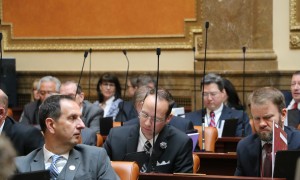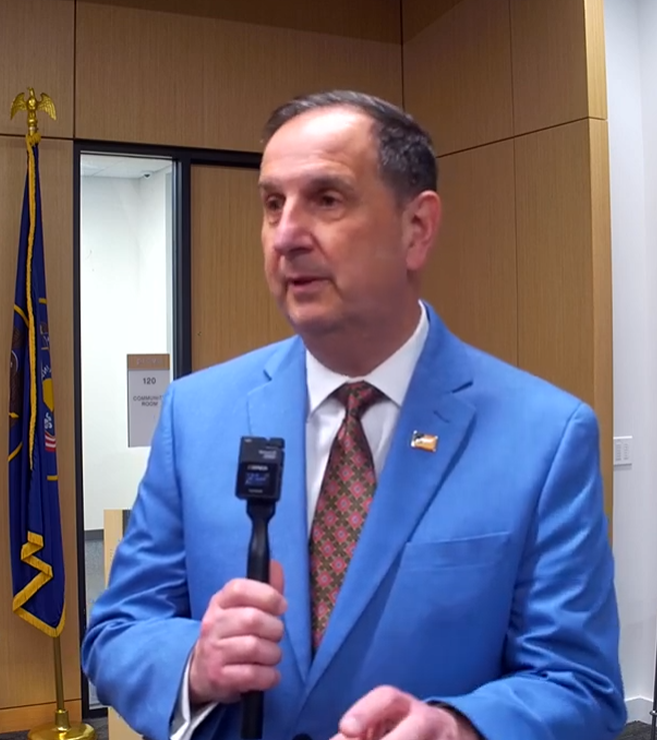

I recently had the opportunity to participate in the BYU Political Science Association candidate forum to discuss the most pressing issues facing Utah House District 62. As an economist, my approach to every issue rests on evidence-based decision-making and long-term fiscal stewardship. Since we couldn’t cover every topic during the live event, I have published all 11 forum questions along with my full responses below for full transparency with our community.
- Jump to Question 1: Housing Affordability & Subsidies
- Jump to Question 2: Land-Use & Corridor Preservation
- Jump to Question 3: Infrastructure Funding & Stress-Testing
- Jump to Question 4: Competency-Based Education
- Jump to Question 5: State vs. Local Control (Subsidiarity)
- Jump to Question 6: Water Policy, Growth & Data Centers
- Jump to Question 7: Independent Agency Oversight (MIDA / SITLA)
- Jump to Question 8: Redistricting & Process vs. Outcomes
- Jump to Question 9: Declining K-12 Enrollment & Fixed Costs
- Jump to Question 10: Amendment B & Tax Policy Supermajorities
- Jump to Question 11: Legislative Bill Volume & Public Choice
Question 1: Housing Affordability & Demand-Side Subsidies
Housing affordability is one of the top concerns for young families and college graduates in Utah. How should the state address housing supply and affordability without inflating market prices.
“When government subsidizes demand in a constrained market, it doesn’t lower housing prices—it simply inflates the clearing price and transfers taxpayer dollars into higher land values.”
“The fundamental issue in housing affordability comes down to basic supply and demand economics. When demand outpaces supply, prices rise. The most common political temptation is to introduce demand-side subsidies—such as down-payment assistance or buyer grants. However, when government subsidizes demand in a market with fixed supply, it doesn’t lower prices; it simply shifts the demand curve upward, raising home prices further and transferring public funds into real estate equity.
The state’s role must focus exclusively on supply-side constraints and infrastructure. High housing costs in Utah are largely driven by local zoning bottlenecks, slow permitting processes, and the high front-end cost of municipal infrastructure (water, sewer, and roads). The Legislature can help cities build more housing by funding regional infrastructure upfront, streamlining local development reviews, and encouraging high-density zoning around transit corridors, allowing private supply to meet market demand naturally.”
Question 2: Land-Use & Corridor Preservation
Utah is experiencing rapid population growth. How do we balance state transportation planning with local land-use authority?
“Corridor preservation is the ultimate hedge against future tax inflation—buying right-of-way decades in advance saves taxpayers millions in land acquisition and condemnation costs.”
“Balancing state transportation priorities with local land-use control requires proactive coordination rather than state mandates. Transportation corridors—highways, arterial roads, and transit lines—are regional assets, while land-use zoning is a local prerogative. Conflict arises when the state plans a corridor after local development has already built up around it, forcing expensive property acquisition and eminent domain disputes.
The economic solution is aggressive corridor preservation. By acquiring right-of-way decades before development occurs, the state protects future transportation routes at a fraction of the cost. Local municipalities can then plan their commercial and residential zoning around established corridors with full predictability. This preserves local zoning authority while ensuring our regional transport network expands efficiently to support growth.”
Question 3: Infrastructure Funding & Fiscal Resilience
How should Utah manage its long-term capital investments and guard state budgets against potential economic downturns?
“Fiscal resilience isn’t just about saving money in a rainy day fund; it requires stress-testing state budgets against multi-year revenue shocks before downturns happen.”
“Utah’s economic success relies on rigorous fiscal discipline and structural stress-testing. Rather than budgeting based on peak revenue cycles, the state must evaluate how revenue sources—such as sales and income taxes—perform under severe economic downturns.
Our capital infrastructure strategy must prioritize paying cash for long-term assets during growth periods while maintaining robust rainy day reserves. By stress-testing agency budgets and bonding limits annually, we ensure that critical public infrastructure projects continue moving forward without requiring emergency tax hikes or slashing essential public services when economic growth slows.”
Question 4: Competency-Based Education & Public School Funding
How can Utah modernize its K-12 education system to ensure students are prepared for the modern economy?
“Education policy should focus on mastery, not seat time. Funding models must reward student competency and demonstrated knowledge rather than raw hours spent in a classroom.”
“Traditional K-12 education funding and structure are built on ‘seat time’—the assumption that spending a fixed number of hours in a classroom equates to learning. In a modern economy, we must shift toward competency-based education, where advancement is driven by demonstrated mastery of subject matter rather than calendar time.
This model allows advanced students to accelerate through coursework while giving students who need extra help the targeted time required to master core concepts. State funding formulas should provide flexible tools for school districts to adopt competency-based credentials, incentivizing outcomes, teacher quality, and individualized learning pathways over administrative headcounts.”
Question 5: State vs. Local Balance & Subsidiarity
In Utah, local governments are creations of the state. What is the ideal balance between state legislative authority and municipal autonomy?
“The goal of subsidiarity is matching the scale of the problem to the right level of government: the state shouldn’t fill local potholes, and cities shouldn’t have to manage statewide public health systems.”
“Under Utah’s constitutional framework, local governments are political subdivisions of the state operating under statutory delegation. The ideal balance comes down to the core policy principle of subsidiarity: governance decisions should always be made as close to the people as possible—where local responsiveness is highest.
The key word, however, is possible. The state legislature shouldn’t be deciding where a city fills potholes or plans neighborhood parks. Conversely, individual municipalities shouldn’t be asked to handle regional transit or statewide public health systems on their own. The state should only intervene when local issues create cross-border externalities—regional impacts like transportation networks, water management, or housing supply bottlenecks that cross municipal boundaries. The state’s role is setting broad framework standards, while leaving local execution to city officials who know their communities best.”
Question 6: Water Policy, Growth & Industrial Data Center Use
How does Utah balance water conservation with rapid population growth, agricultural needs, and industrial users like data centers?
“Water policy requires the same long-term economic discipline as state highway planning. We must use market-based agricultural leasing and strict industrial transparency to secure our water future.”
“Balancing water conservation with growth requires treating water with the same long-term fiscal discipline we apply to transportation infrastructure. Utah faces over $59 billion in long-term water infrastructure needs by 2060 across drinking water systems, quality upgrades, and agricultural canals.
For large commercial users like data centers, state policy must mandate absolute transparency and strict efficiency standards. House Bill 76 established public reporting for data center water usage, and we must require new industrial facilities to utilize closed-loop, non-evaporative cooling systems to protect municipal supplies.
For agriculture, we shouldn’t force a choice between farming and growth. Through voluntary, market-based initiatives like Dedicated Water Amendments (HB 348), farmers can upgrade irrigation efficiency and lease conserved water for downstream needs—such as the Great Salt Lake—without risking the loss of their underlying water rights. Over $300 million has been invested in Great Salt Lake preservation; combining voluntary agricultural leasing with strict industrial accountability ensures long-term water security for Utah.”
Question 7: Independent Agency Oversight & Governance
Independent bodies like MIDA or SITLA possess unique tax and land-use powers. How should the state approach regulating and overseeing these organizations?
“Sweeping administrative authority must always be matched with public accountability. Special state entities cannot be allowed to bypass local land-use authority without local consent.”
“When state entities like MIDA or SITLA are granted special land-use, bonding, or tax increment powers, maintaining statutory oversight is essential to protect local tax bases. Legislative oversight falls short when broad delegations allow these organizations to expand beyond their core mission, overriding municipal zoning or capturing property tax revenue without sufficient local concurrence.
The state must enforce a three-part regulatory approach:
- Scope Guardrails: Narrow statutory triggers to prevent independent authorities from expanding project boundaries arbitrarily outside their core statutory purpose.
- Local Government Consent: Require explicit approval from affected city and county governments before tax increments are diverted or local land-use authority is altered.
- Audit Transparency: Subject all public-private development agreements to regular performance audits by the Legislative Auditor General and strict open-meeting compliance.”
Question 8: Redistricting Process & Government Branch Balance
Redistricting remains a deeply debated topic in Utah. What is your perspective on the redistricting process and government branch authority?
“Math is neutral. Utah’s natural political geography inherently defaults to a 4-0 map baseline—forcing a 3-1 outcome isn’t removing political engineering, it requires it.”
“My approach to redistricting rests on a core standard: process matters more than guaranteed political outcomes. There are two forms of gerrymandering—cracking and packing—and both lead to the same flaw: general elections lose competitive meaning because party nominees are virtually guaranteed to win. We see this nationwide, whether by Republicans in Texas or Democrats in California.
I supported the fundamental premise behind Proposition 4—creating competitive races where voters decide outcomes in November. However, the ideals of Prop 4 have been hijacked by those who value partisan outcomes over fair process. They don’t want competitive races; they want a guaranteed outcome—whatever map forces a Democratic district in Utah.
As an economist looking at spatial data, math is neutral. Given Utah’s natural political geography, a 4-0 outcome is the un-engineered default baseline. Moving to a safe 3-1 map requires deliberate political engineering. Historically, Utah is far less gerrymandered than critics claim; voters have repeatedly elected Democrats to Congress—such as Jim Matheson and Ben McAdams—when candidates presented moderate, competitive platforms.
The ideal redistricting process isn’t engineering safe havens for either party. It’s establishing neutral, objective rules—preserving municipal integrity, compact boundaries, and allowing competitive elections to happen naturally.”
Question 9: Declining K-12 Student Enrollment & Budget Adaptation
As Utah experiences declining K-12 enrollment for the first time, how should the Legislature adapt public education funding?
“Fixed operational costs don’t shrink automatically when student counts drop. Declining enrollment must be managed with transition support while reinvesting savings directly into classroom quality.”
“Declining K-12 student enrollment presents a structural fiscal challenge because school districts operate with high fixed costs—such as school facility maintenance, utility overhead, and administration—that do not shrink proportionally when student headcounts fall. If state funding shifts strictly on a rigid per-pupil basis, local school operational budgets can experience sudden fiscal instability.
The Legislature should navigate this demographic shift through three strategic actions:
- Transition Adjustment Support: Provide multi-year funding cushions for school districts actively right-sizing facilities or consolidating underutilized campuses.
- Reinvesting Savings in Quality: Leverage smaller student populations as an opportunity to reinvest structural savings directly into higher teacher pay, classroom resources, and early literacy instruction.
- WPU Formula Modernization: Adjust state Weighted Pupil Unit (WPU) formulas to ensure fixed physical plant costs are adequately supported while preserving flexible funding options.”
Question 10: Amendment B & Supermajority Requirements for Tax Initiatives
Do you support Amendment B, which would require a 60% supermajority voter threshold for citizen ballot initiatives that change tax policy?
“Majoritarian tax policy creates a economic trap: when 97% of voters can pass a tax increase paid for by 3%, it destabilizes state economic growth. High standards must apply to both direct ballot initiatives and legislative tax votes.”
“I support Amendment B because long-term tax policy shouldn’t be dictated by simple majoritarian arithmetic.
Look at what is happening right now in Colorado. A statewide initiative was introduced proposing to raise over $2.5 billion in taxes targeted at just 3% of the population to fund programs for the remaining 97%. When 97% of voters are told they can vote for spending or tax cuts paid for entirely by someone else, a simple 50%+1 majority creates a severe majoritarian trap. It penalizes job creators, destabilizes the tax base, and harms economic competitiveness—all passed on a narrow margin. Requiring a 60% supermajority ensures that ballot-initiative tax changes require broad statewide consensus.
Critics often argue that this creates a double standard because the state legislature can pass tax changes with a simple majority. That is a fair critique. That is why I am actively working on policy reforms to make it harder and vastly more transparent for the Legislature to raise taxes as well—requiring higher public notice standards, explicit fiscal stress-testing, and procedural hurdles before any legislative tax increase can advance. Sound tax policy requires stability whether passed at the ballot box or in the State Capitol.”
Question 11: Legislative Bill Volume & Public Choice
Is the growing number of bills introduced each legislative session a problem, and should Utah limit bill filings?
“Capping the number of bills forces lawmakers to bundle unrelated policies into massive omnibus packages. That harms transparency and public choice.”
“The growth in bill volume is an intriguing political science question because the underlying causes are complex. Is bill volume rising because lawmakers are breaking large proposals into smaller, single-issue bills? Is it driven by pent-up demand in a fast-growing state during a brief 45-day session? Or has modern drafting technology made committee work simply more efficient?
Many critics jump straight to proposing artificial caps on bill filings. However, from a public choice economics perspective, arbitrary bill limits create a serious flaw: capping bill numbers forces legislators to bundle unrelated policy proposals into massive, complex omnibus bills.
That kind of omnibus bundling is bad for public choice and transparency. It forces representatives to vote on single bills that contain policies they strongly support alongside policies they oppose, rather than evaluating each policy on its own merits. The higher bill volume seen today is a reflection of a streamlined legislative drafting process. The true test of governance isn’t the raw count of bills on a calendar—it’s whether the bills that pass constitute sound, evidence-based policy for Utah.”